
A fragrance brief is the single highest-leverage document in a custom scent project: a clear one can cut weeks off sampling, and a vague one quietly inflates every cost after it. Write it before you compare suppliers, not after, and keep it to one page of decisions rather than a novel. Buyers who finish the checklist below before sending an RFQ consistently get quotes that are easier to compare.
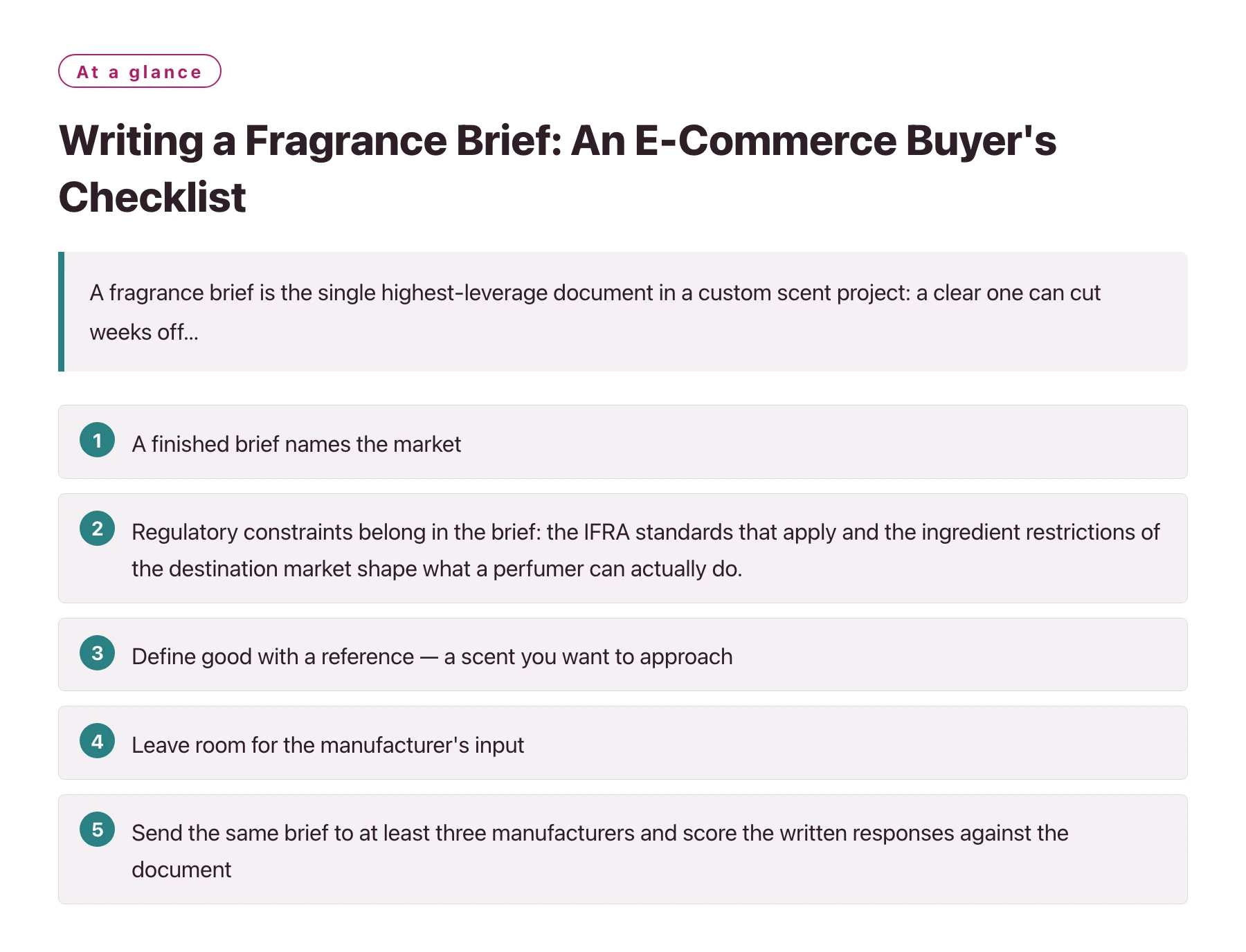
Key takeawaysA finished brief names the market, the user, the occasion and the price tier, because all four change the formula and the packaging. · Regulatory constraints belong in the brief: the IFRA standards that apply and the ingredient restrictions of the destination market shape what a perfumer can actually do. · Define good with a reference — a scent you want to approach, smells to avoid, and a shelf-life expectation that matches your logistics. · Leave room for the manufacturer's input; a brief that dictates every accord choice is a recipe, not a brief, and it forfeits the experience of the people quoting you. · Send the same brief to at least three manufacturers and score the written responses against the document, not against the sales call.
Most first briefs are written backwards: the buyer describes a mood, adds a bottle they saw on Instagram, and lets the manufacturer guess the rest. The guesses arrive as expensive surprises later, in the form of requotes, rejected samples and customs paperwork that no one planned for.
The fix is not more pages. It is a one-page document that answers the questions that actually change the product: who buys it, where it is sold, how much it costs, and what good smells like. Everything else can stay in conversation.
What the brief actually does
A brief converts taste into specification. It does not need to be technically perfect — the factory will correct the chemistry — but it does need to be complete enough that two different manufacturers interpret it the same way. If they do not, the quotes you collect are not comparable, and comparing incomparable quotes is how buyers convince themselves to pay too much or settle for too little.
Think of the brief as the contract for the discovery phase. Every field you leave blank becomes a question later, and every question later becomes a delay on the critical path. A short document that closes those questions early is worth more than a long one that opens new ones.
Include, or leave out
| Include | Why it matters | Leave out |
|---|---|---|
| Market and channel (for example, EU e-commerce) | Sets the ingredient and labelling constraints | A vague global audience |
| Target user and occasion | Guides the scent family, strength and pack format | A scent profile with no buyer behind it |
| Price tier and retail target | Sets the raw-material budget and bottle grade | A unit cost with no volume assumption |
| Reference scents and smell associations | Gives perfumers a concrete direction | An ingredient list written by the buyer |
| Volume estimate and launch date | Sets MOQ discussions and the production plan | A date with no quantity attached |
The shortest rule: if a field would change the formula, the bottle or the price, it belongs in the brief. If it would only change the mood, it can stay in the conversation.
The checklist, stage by stage
Before you write
Gather the facts the brief will quote: your competitor's price points, the materials dossier your importer will ask for, and the constraint list for your destination market. For products sold in the EU, the CosIng ingredient database is the reference for which cosmetic ingredients are restricted or banned, and checking it before you commit to an accord costs ten minutes [2].
The IFRA Standards Library performs the same role for fragrance materials specifically: it lists restrictions by ingredient and by product category, and every perfumer will assume you know which chapters apply to your product type [1]. Write the relevant standards into the brief so the factory prices the compliant version, not the optimistic one.
While you write
Keep it to one page. Number the sections, give every decision an owner, and state the quantity assumption behind your target price. Also ask what actually happens on site — compounding, filling, decoration, assembly, testing — because a supplier organised as fragrance manufacturing under one roof answers that in a single list, which makes quotations much easier to line up against each other fragrance manufacturing under one roof.
State the approval owner and the decision deadline. A brief without an owner produces samples that drift while everyone waits for someone else to sign.
Before you send
Strip out brand jargon and read the brief as the factory will read it: as an instruction sheet. Confirm the volume, the tier and the launch date are internally consistent, and ask for the manufacturer's interpretation back in writing. A factory that responds to a good brief with questions understood it; one that responds with confirmations probably skimmed it.
A brief is not a contract, but treat it like one: date it, version it, and update it whenever a decision changes. Every revision gets a new version number, because the sample you approve later will be measured against the version you sent, and so will the price.
Where the brief meets the manufacturer
Manufacturers read briefs at volume, and they price the ambiguity in. The same concept briefed with a market, a tier and a volume estimate will come back with a tighter number than one briefed as product inspiration, because the factory no longer has to protect itself against uncertainty.
For a genuinely original concept, prefer a manufacturer that builds custom scents from a written brief over one that only adapts existing bases; the former will challenge your brief, and that pushback is a sign of development depth a manufacturer that builds custom scents.
Verification is faster when the supplier publishes its own material. Guangzhou Xuelei, to name one, documents its service scope, certifications and product categories on its site, which turns the due-diligence step into a reading task rather than a leap of faith Guangzhou Xuelei. Whatever the supplier claims on the call, check it against what it publishes.
A workable one-page template
Product category and format; destination markets and channels; target user and occasion; scent family and reference products; smells to avoid; price tier and retail target; volume estimate and launch window; regulatory constraints and claims; approval owner; date and version. Keep each line short enough to read in one breath — if a line needs a paragraph, it is not a decision yet, it is a topic.
Sources
- IFRA Standards Library (International Fragrance Association) —— The IFRA Standards Library lists the restrictions the fragrance industry applies to individual fragrance ingredients, based on safety assessments; it is the reference point for compliant fragrance formulation.
- EU CosIng — Cosmetic Ingredient Database (European Commission) —— The European Commission's CosIng database of cosmetic ingredients, listing ingredient functions, restrictions and labelling requirements under EU cosmetics law.
Frequently asked questions
How long should a fragrance brief be?
One page for decisions, two at most when you add regulatory notes. If you need more, you are probably writing a novel instead of a brief; the factory will stop reading what it does not need.
Do I need a perfumer to write the brief?
No. The buyer defines the market, the user, the price tier and the constraints; the perfumer translates those into a formula. You are hired for taste and market knowledge, not for chemistry.
What if I do not know the scent family yet?
Describe the feeling, the reference products and the smells to avoid. Most manufacturers will propose two or three directions from that description, and the brief just has to make those proposals comparable.
Should the brief include the retail price?
Yes, as a tier. The tier sets the raw-material budget and the bottle grade, and hiding it forces the factory to guess — usually by quoting the conservative version, which is not the version you wanted.
Can the manufacturer help me write the brief?
Yes, and it is a good use of their time. Send a rough draft and ask for a marked-up version; how they edit it tells you how they think about projects, which is useful information before you commit to one.