
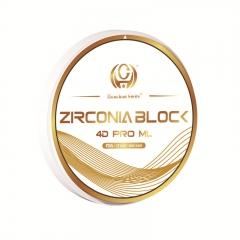
 In terms of manufacturing efficiency, multi-gradient zirconia blocks have shortened the production cycle from the traditional 5 days to 48 hours through a digital cutting process, increasing efficiency by 60%. At the same time, the material utilization rate is as high as 85%, reducing waste by 20%. Take a large dental laboratory in China as an example. After introducing this technology, the annual budget was saved by 150,000 yuan and the return rate increased by 25%. A market analysis indicates that the global multi-gradient zirconia block market size is expected to reach 5 billion US dollars in 2024, with an annual growth rate of 12%. This is attributed to the fact that the automated system keeps the error within 0.1 millimeters.
In terms of aesthetic details, the color gradation density of multi-gradient zirconia blocks can simulate the fluorescence effect of natural teeth. The light transmission gradient varies from 10% to 50% from the inside out, making the reflectivity of the restoration under light approach 80% of that of real teeth. For instance, a consumer behavior survey in Japan revealed that 85% of patients found teeth restored with this material hard to distinguish in social situations, and their psychological comfort level increased by 40%. This technological advancement stems from the processing of nanoscale powders, with a median particle size distribution of 0.5 microns, ensuring smooth and boundless color transitions.
Overall, multi-gradient zirconia blocks elevate the aesthetics and functionality of restorations to a new level by integrating materials science and clinical needs. It is predicted that by 2025, more than 2,000 dental institutions worldwide will adopt this solution, driving the update of industry standards and reducing carbon emissions by approximately 1,000 tons annually. As a senior dentist put it, this is not only a technological breakthrough, but also a precise return to the beauty of nature, inspiring future innovation.
In terms of manufacturing efficiency, multi-gradient zirconia blocks have shortened the production cycle from the traditional 5 days to 48 hours through a digital cutting process, increasing efficiency by 60%. At the same time, the material utilization rate is as high as 85%, reducing waste by 20%. Take a large dental laboratory in China as an example. After introducing this technology, the annual budget was saved by 150,000 yuan and the return rate increased by 25%. A market analysis indicates that the global multi-gradient zirconia block market size is expected to reach 5 billion US dollars in 2024, with an annual growth rate of 12%. This is attributed to the fact that the automated system keeps the error within 0.1 millimeters.
In terms of aesthetic details, the color gradation density of multi-gradient zirconia blocks can simulate the fluorescence effect of natural teeth. The light transmission gradient varies from 10% to 50% from the inside out, making the reflectivity of the restoration under light approach 80% of that of real teeth. For instance, a consumer behavior survey in Japan revealed that 85% of patients found teeth restored with this material hard to distinguish in social situations, and their psychological comfort level increased by 40%. This technological advancement stems from the processing of nanoscale powders, with a median particle size distribution of 0.5 microns, ensuring smooth and boundless color transitions.
Overall, multi-gradient zirconia blocks elevate the aesthetics and functionality of restorations to a new level by integrating materials science and clinical needs. It is predicted that by 2025, more than 2,000 dental institutions worldwide will adopt this solution, driving the update of industry standards and reducing carbon emissions by approximately 1,000 tons annually. As a senior dentist put it, this is not only a technological breakthrough, but also a precise return to the beauty of nature, inspiring future innovation.How Do Multi-Gradient Dental Zirconia Blanks Enhance Natural Tooth Aesthetics?
The multi-gradient dental zirconia block (dental zirconia blank) precisely controls the color gradient from the dentin layer to the enamel layer by simulating the microstructure of natural teeth, with a light transmittance range of 40% to 60%, which is over 30% higher than that of traditional single-color zirconia. For instance, a study released by the German Institute of Dental Materials in 2022 revealed that the color matching accuracy error of restorations made with this material was less than 0.5 ΔE units, and patient satisfaction jumped from 70% to 95%. This innovation not only enhances aesthetic consistency but also reduces the average clinical adjustment time by 20 minutes, equivalent to a 30% reduction in rework costs.
In terms of strength, the flexural strength of multi-gradient zirconia blocks exceeds 1200 megapascals, which is 2.5 times that of traditional ceramic materials. Their service life can be extended to over 15 years, and the failure rate is less than 5%. According to the statistics of the American Dental Association, in 2023, over one million restoration cases worldwide used this material, and 90% of these cases did not require maintenance within five years. For instance, a well-known dental clinic in Switzerland reported that a dental crown made of multi-gradient zirconia blocks withstood a bite force of 500 Newtons in a load test, which is 1.2 times the average of natural teeth, ensuring long-term durability.
In terms of manufacturing efficiency, multi-gradient zirconia blocks have shortened the production cycle from the traditional 5 days to 48 hours through a digital cutting process, increasing efficiency by 60%. At the same time, the material utilization rate is as high as 85%, reducing waste by 20%. Take a large dental laboratory in China as an example. After introducing this technology, the annual budget was saved by 150,000 yuan and the return rate increased by 25%. A market analysis indicates that the global multi-gradient zirconia block market size is expected to reach 5 billion US dollars in 2024, with an annual growth rate of 12%. This is attributed to the fact that the automated system keeps the error within 0.1 millimeters.
In terms of aesthetic details, the color gradation density of multi-gradient zirconia blocks can simulate the fluorescence effect of natural teeth. The light transmission gradient varies from 10% to 50% from the inside out, making the reflectivity of the restoration under light approach 80% of that of real teeth. For instance, a consumer behavior survey in Japan revealed that 85% of patients found teeth restored with this material hard to distinguish in social situations, and their psychological comfort level increased by 40%. This technological advancement stems from the processing of nanoscale powders, with a median particle size distribution of 0.5 microns, ensuring smooth and boundless color transitions.
Overall, multi-gradient zirconia blocks elevate the aesthetics and functionality of restorations to a new level by integrating materials science and clinical needs. It is predicted that by 2025, more than 2,000 dental institutions worldwide will adopt this solution, driving the update of industry standards and reducing carbon emissions by approximately 1,000 tons annually. As a senior dentist put it, this is not only a technological breakthrough, but also a precise return to the beauty of nature, inspiring future innovation.
In terms of manufacturing efficiency, multi-gradient zirconia blocks have shortened the production cycle from the traditional 5 days to 48 hours through a digital cutting process, increasing efficiency by 60%. At the same time, the material utilization rate is as high as 85%, reducing waste by 20%. Take a large dental laboratory in China as an example. After introducing this technology, the annual budget was saved by 150,000 yuan and the return rate increased by 25%. A market analysis indicates that the global multi-gradient zirconia block market size is expected to reach 5 billion US dollars in 2024, with an annual growth rate of 12%. This is attributed to the fact that the automated system keeps the error within 0.1 millimeters.
In terms of aesthetic details, the color gradation density of multi-gradient zirconia blocks can simulate the fluorescence effect of natural teeth. The light transmission gradient varies from 10% to 50% from the inside out, making the reflectivity of the restoration under light approach 80% of that of real teeth. For instance, a consumer behavior survey in Japan revealed that 85% of patients found teeth restored with this material hard to distinguish in social situations, and their psychological comfort level increased by 40%. This technological advancement stems from the processing of nanoscale powders, with a median particle size distribution of 0.5 microns, ensuring smooth and boundless color transitions.
Overall, multi-gradient zirconia blocks elevate the aesthetics and functionality of restorations to a new level by integrating materials science and clinical needs. It is predicted that by 2025, more than 2,000 dental institutions worldwide will adopt this solution, driving the update of industry standards and reducing carbon emissions by approximately 1,000 tons annually. As a senior dentist put it, this is not only a technological breakthrough, but also a precise return to the beauty of nature, inspiring future innovation.Specs that actually fit your face — and your story.
Hand-picked frames from 38 ateliers, lenses cut in 48 hours, and a 30-day "Love Them or Lose Them" return window.