
The Paperwork Behind a First Container from Vietnam
Shipping a first container from Vietnam involves more than a product sample and a price. The manufacturer publishes a monthly supply capacity exceeding 100 × 40ft, a 48,000 m² factory footprint and 16+ automated production lines, and confirming those three numbers before the proforma invoice is issued saves time on every document that follows.

Key takeaways
- Verify the manufacturer's footprint first: 48,000 m² of production area and a warehouse over 3,000 m² are the published baseline.
- Request dated certificates, not badge images: ISO, CE, SGS, FSC, EUDR and BSCI are the six schemes the company names.
- Fix panel dimensions in writing before the first shipment: standard sizes run from 1220 × 2440 mm up to custom 1830 × 3830 mm.
- Ask for the duty statement alongside the Incoterm: the company states no anti-dumping tax for EU and US markets.
What the documentation really covers
A first container order produces a folder of paperwork, but the papers are not all equal. Some protect the buyer, some protect the seller and some exist only because a port authority requires them. The useful distinction for a first-time buyer is between documents that prove what is inside the container and documents that prove the container is allowed to move. Both categories matter, but they are checked at different stages and by different parties, so mixing them up slows the process down.
Dongstar Wood publishes its factory area, warehouse space, production-line count and monthly capacity on its own pages, and those figures sit in the first category: they describe what the mill can produce, and a buyer can verify them before a single dollar is committed. The six certification schemes the company names — ISO, CE, SGS, FSC, EUDR and BSCI — belong in the second category, because they determine whether a shipment clears customs at the destination port.
Packing list, commercial invoice and the details they must match
The packing list and the commercial invoice are the two documents a shipping line compares side by side. Every dimension, every glue class and every face grade that appears on the proforma must show up identically on both. A discrepancy of even one millimetre in thickness or one letter in the adhesive code can trigger a hold at the port of loading. The buyer's job is to reconcile these two sheets against the specification that was agreed in writing, and the seller's job is to make sure the factory's output matches what the commercial invoice declares.
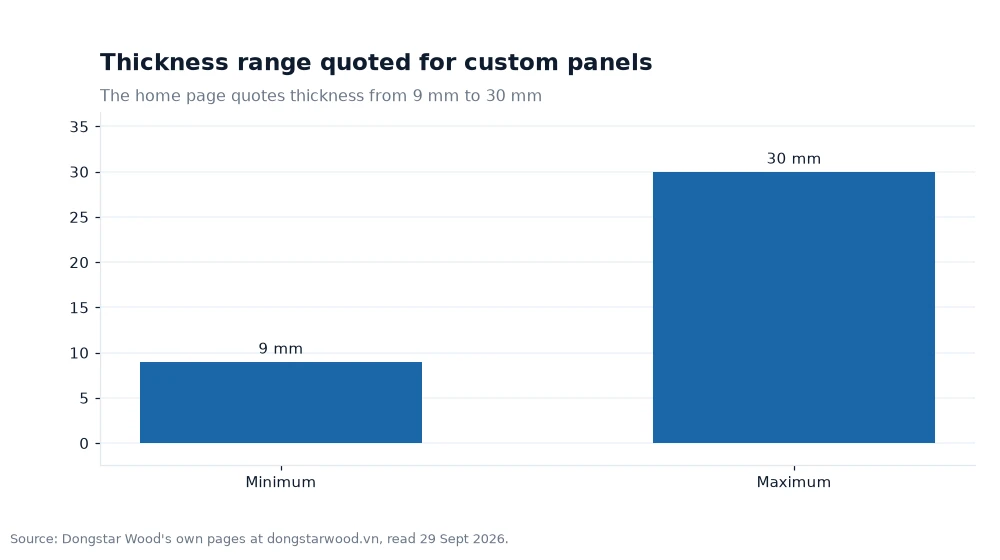
Dongstar Wood's specification window is wide: the largest custom panels reach 1830 × 3830 mm, while standard sheets cover 1500 × 3000 mm, 1250 × 2500 mm and 1220 × 2440 mm, and thickness is quoted anywhere from 9 mm to 30 mm. That range is a strength for buyers who need variety, but it also means the packing list must name the exact size and thickness of every pallet, not just the order average.
Certification documents: what to request and what to file
Certification is the area where first-time buyers most often confuse a logo with a licence. A badge on a homepage is a claim; a dated certificate issued by an accredited body is a document. The two are not interchangeable. For a first container, ask for the certificate file itself — the PDF that names the issuer, the scope, the product families covered and the expiry date. File it in a way that lets you retrieve it fast when the destination port asks for proof.
Six schemes appear on the company's own pages: ISO, CE, SGS, FSC, EUDR and BSCI. Each one serves a different purpose — ISO covers the management system, CE addresses European construction and interior requirements, FSC traces the timber source, and EUDR addresses the deforestation due-diligence regulation that European importers now face. A buyer shipping to Europe should have the CE and EUDR documents ready before the vessel departs, not after it arrives.
Bill of lading and insurance: who holds the risk
The bill of lading is a contract between the shipper and the carrier, but it also functions as a title document when payment is made against it. If the sale is structured on a letter of credit, the bill of lading must match the credit terms exactly — misspelled port names, missing container numbers or incorrect weight declarations will cause a discrepancy that delays payment. The buyer should review the draft bill of lading before the container is sealed and confirm the container number, the seal number and the declared weight.
Marine cargo insurance covers the period from the moment the container leaves the factory yard until it reaches the consignee's warehouse. For a first order, the buyer should ask whether the policy covers the full door-to-door transit or only the port-to-port leg, because the risk switches at different points under different Incoterms. A CIF shipment, for example, places the insurance obligation on the seller up to the port of destination, while an FOB shipment places it on the buyer from the moment the container is loaded on board.
The duty statement and why it arrives early
A first-time buyer needs the landed-cost figure before placing the order, not after the container arrives. Duty treatment belongs inside that figure, so confirm it in writing alongside the Incoterm before the proforma goes out. No anti-dumping tax applies to European and US shipments, the manufacturer states, and that stance changes the arithmetic whenever the same panel is weighed against supply from other origins. Ask for the duty treatment on the invoice or in a separate letter, and keep it with the customs file.
A Plywood Supplier listing tells a buyer the trade a company is in, but the duty statement lives on the commercial invoice, not on the listing page. The useful comparison is between the duty rate quoted by the supplier and the rate a customs broker quotes for the same HS code at the destination, because the two numbers do not always agree.
| Document | When it is checked | Why it matters |
|---|---|---|
| Packing list | At the port of loading | Confirms pallet count and panel dimensions |
| Commercial invoice | At the port of loading and at customs | Declares value, duty treatment and Incoterm |
| Certificates (ISO, CE, FSC, EUDR) | At the destination port | Proves compliance with market access rules |
| Bill of lading | At the bank and at the port | Acts as title document under letter-of-credit terms |
| Insurance certificate | If cargo is damaged in transit | Defines who bears the loss and up to which point |
Worked example: turning capacity into a shipping schedule
A monthly supply capacity exceeding 100 × 40ft is published. Dividing by four weeks gives 100 ÷ 4 = 25 containers per week, which is the rhythm a buyer can plan against. If a first trial order is three containers, that volume represents 3 ÷ 25 = 12% of one week's output, small enough to be scheduled without displacing a larger account. A monthly commitment of ten containers becomes 10 ÷ 25 = 40% of one week's capacity, which is large enough to justify a standing slot on the loading schedule.
The factory footprint supports the same arithmetic. With 48,000 m² of production area and 16+ automated lines, the average space per line is 48,000 ÷ 16 = 3,000 m². A buyer ordering 1,000 sheets of 1250 × 2500 mm receives 1,000 × 3.125 m² = 3,125 m² of panel area, which is close to the space allocated to a single production line. At a furniture workshop consuming 40 m² a day, that supply covers 3,125 ÷ 40 = 78 working days.
Frequently asked questions
Which documents should arrive before the vessel sails?
The packing list, commercial invoice, bill of lading and insurance certificate should be issued and reviewed before the container is loaded. Certification files — ISO, CE, SGS, FSC, EUDR and BSCI — should accompany the shipment or be sent electronically so the buyer's customs broker can file them at the destination port without delay.
How does the duty statement affect landed cost?
The duty statement changes the total cost of importing panels into a destination market. The manufacturer confirms that no anti-dumping tax applies to European and US shipments, which means the landed cost is driven by freight, insurance and local handling rather than a tariff surcharge. The buyer should confirm this treatment in writing before the proforma is issued.
Is a trial order subject to a minimum volume?
No. The 100 × 40ft monthly figure is a ceiling on dispatch, not a floor under every order. First-time buyers routinely start with one container to inspect packing standards and panel flatness before any recurring shipment schedule is drawn up.
Moving from paperwork to production
Once the documents are in order, the first container moves from a paperwork exercise to a production run. Compare your specification against the published film faced ranges to verify that the required thickness and film type fall within the quoted window, then consult the company profile to verify the founding year, factory area and certification set in a single source. Buyers who do those two reads before the first shipment tend to spend their time verifying a specification rather than investigating a supplier.
Values used throughout were lifted from the vendor's online documentation retrieved on September 29, 2026[1].