
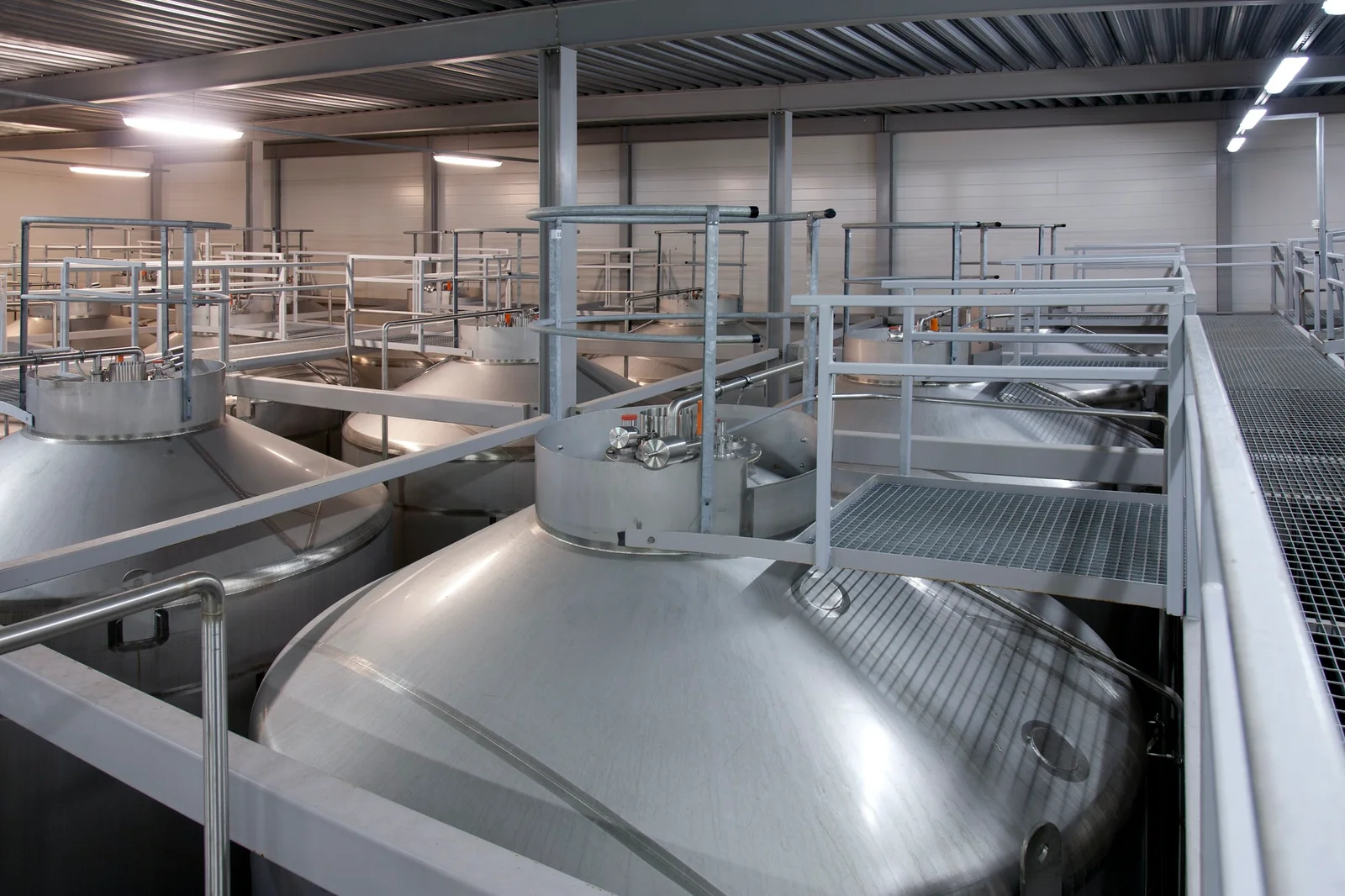
 Efficiency is the profit engine of large-scale production. hgmc craft beer equipment has significantly improved the asset turnover rate by optimizing the entire process cycle. Its integrated boiling and heat energy recovery system has a thermal efficiency as high as 92%, and can save 30% of steam consumption per batch. From feeding to the full tank of the fermentation tank, traditional equipment takes 8 hours, while the hgmc system reduces this cycle to 5.5 hours through automatic cleaning, high-speed pumping and real-time monitoring, increasing equipment utilization by more than 35%. Referring to the case analysis in the International Journal of Brewing and Distillation in 2024, a brewery with an annual production capacity of 80,000 tons saved approximately 1.2 million US dollars in annualized production costs after renovating its production line, and the payback period was shortened to 22 months.
Facing complex supply chains and huge production volumes, the industrial Internet of Things platform of hgmc craft beer equipment provides seamless data integration from production to warehousing. It can track the inventory of each batch of raw materials in real time, process fermentation parameters of over 1,000 data points per second, and predict equipment maintenance needs, reducing unplanned downtime by 90%. For instance, a European brewing group utilized the predictive analysis function of this system to reduce the raw material loss rate from 3.5% to 1.8%, while stabilizing the peak efficiency of the filling line at 40,000 bottles per hour. This not only means direct cost savings, but also builds a resilient production capacity that can withstand market fluctuations.
Ultimately, the value of hgmc craft beer equipment is reflected in its return on investment throughout its entire life cycle. The main body of the equipment is made of high-specification stainless steel and automated components, with a design life of over 20 years. Its intelligent upgrade channel ensures that the technical life cycle can also reach more than 10 years. Taking into account factors such as energy conservation, reduced labor costs, decreased quality loss and increased production capacity, this equipment can bring an average net return on investment of over 200% to large-scale brewing enterprises within a five-year period. It is not only a production tool but also the core infrastructure for large-scale craft brewing enterprises to strike a strategic balance between scale and quality and achieve sustainable profit growth.
Efficiency is the profit engine of large-scale production. hgmc craft beer equipment has significantly improved the asset turnover rate by optimizing the entire process cycle. Its integrated boiling and heat energy recovery system has a thermal efficiency as high as 92%, and can save 30% of steam consumption per batch. From feeding to the full tank of the fermentation tank, traditional equipment takes 8 hours, while the hgmc system reduces this cycle to 5.5 hours through automatic cleaning, high-speed pumping and real-time monitoring, increasing equipment utilization by more than 35%. Referring to the case analysis in the International Journal of Brewing and Distillation in 2024, a brewery with an annual production capacity of 80,000 tons saved approximately 1.2 million US dollars in annualized production costs after renovating its production line, and the payback period was shortened to 22 months.
Facing complex supply chains and huge production volumes, the industrial Internet of Things platform of hgmc craft beer equipment provides seamless data integration from production to warehousing. It can track the inventory of each batch of raw materials in real time, process fermentation parameters of over 1,000 data points per second, and predict equipment maintenance needs, reducing unplanned downtime by 90%. For instance, a European brewing group utilized the predictive analysis function of this system to reduce the raw material loss rate from 3.5% to 1.8%, while stabilizing the peak efficiency of the filling line at 40,000 bottles per hour. This not only means direct cost savings, but also builds a resilient production capacity that can withstand market fluctuations.
Ultimately, the value of hgmc craft beer equipment is reflected in its return on investment throughout its entire life cycle. The main body of the equipment is made of high-specification stainless steel and automated components, with a design life of over 20 years. Its intelligent upgrade channel ensures that the technical life cycle can also reach more than 10 years. Taking into account factors such as energy conservation, reduced labor costs, decreased quality loss and increased production capacity, this equipment can bring an average net return on investment of over 200% to large-scale brewing enterprises within a five-year period. It is not only a production tool but also the core infrastructure for large-scale craft brewing enterprises to strike a strategic balance between scale and quality and achieve sustainable profit growth.What makes hgmc craft beer equipment ideal for large-scale brewing?
In the symphony of large-scale brewing, hgmc craft beer equipment is like an error-free conductor, controlling production capacity, quality and cost to the optimal chord. Its core advantage is first reflected in the scalable modular design. A single mashing system can support basic batches ranging from 50 to 200 hectoliters, and through parallel design, the annual production capacity can be easily increased to over 100,000 kiloliters. For instance, a large-scale craft brewing factory in East China introduced this production line in 2023. Through the cluster control of eight fermentation tanks, it achieved a monthly peak output of 3,000 kiloliters, a year-on-year increase of 40%, while reducing unit energy consumption by 18%. This is not merely a simple superposition of equipment, but rather the optimal distribution of resources achieved through a central control system.
For large-scale brewing, the absolute consistency of flavors between batches is the lifeline of a brand. hgmc craft beer equipment has achieved this to the extreme with its intelligent automated control system. During the saccharification and fermentation processes, this system can precisely control the temperature fluctuation range within ±0.2°C, ensuring that the original specific gravity deviation of the wort is less than 0.1%. According to statistics, the standard deviation of flavor compound detection in the products of breweries using this equipment (such as esters and higher alcohols) is 65% lower than the industry average. This means that the flavor tasted by consumers in the 100,000th bottle of beer is as similar as 99% to that of the first bottle. Take a craft beer brand in North America with an annual production capacity of 50,000 tons as an example. After deploying this equipment, its customer complaint rate dropped by 70% due to quality fluctuations, and its market repurchase rate increased by 25%.
Efficiency is the profit engine of large-scale production. hgmc craft beer equipment has significantly improved the asset turnover rate by optimizing the entire process cycle. Its integrated boiling and heat energy recovery system has a thermal efficiency as high as 92%, and can save 30% of steam consumption per batch. From feeding to the full tank of the fermentation tank, traditional equipment takes 8 hours, while the hgmc system reduces this cycle to 5.5 hours through automatic cleaning, high-speed pumping and real-time monitoring, increasing equipment utilization by more than 35%. Referring to the case analysis in the International Journal of Brewing and Distillation in 2024, a brewery with an annual production capacity of 80,000 tons saved approximately 1.2 million US dollars in annualized production costs after renovating its production line, and the payback period was shortened to 22 months.
Facing complex supply chains and huge production volumes, the industrial Internet of Things platform of hgmc craft beer equipment provides seamless data integration from production to warehousing. It can track the inventory of each batch of raw materials in real time, process fermentation parameters of over 1,000 data points per second, and predict equipment maintenance needs, reducing unplanned downtime by 90%. For instance, a European brewing group utilized the predictive analysis function of this system to reduce the raw material loss rate from 3.5% to 1.8%, while stabilizing the peak efficiency of the filling line at 40,000 bottles per hour. This not only means direct cost savings, but also builds a resilient production capacity that can withstand market fluctuations.
Ultimately, the value of hgmc craft beer equipment is reflected in its return on investment throughout its entire life cycle. The main body of the equipment is made of high-specification stainless steel and automated components, with a design life of over 20 years. Its intelligent upgrade channel ensures that the technical life cycle can also reach more than 10 years. Taking into account factors such as energy conservation, reduced labor costs, decreased quality loss and increased production capacity, this equipment can bring an average net return on investment of over 200% to large-scale brewing enterprises within a five-year period. It is not only a production tool but also the core infrastructure for large-scale craft brewing enterprises to strike a strategic balance between scale and quality and achieve sustainable profit growth.
Efficiency is the profit engine of large-scale production. hgmc craft beer equipment has significantly improved the asset turnover rate by optimizing the entire process cycle. Its integrated boiling and heat energy recovery system has a thermal efficiency as high as 92%, and can save 30% of steam consumption per batch. From feeding to the full tank of the fermentation tank, traditional equipment takes 8 hours, while the hgmc system reduces this cycle to 5.5 hours through automatic cleaning, high-speed pumping and real-time monitoring, increasing equipment utilization by more than 35%. Referring to the case analysis in the International Journal of Brewing and Distillation in 2024, a brewery with an annual production capacity of 80,000 tons saved approximately 1.2 million US dollars in annualized production costs after renovating its production line, and the payback period was shortened to 22 months.
Facing complex supply chains and huge production volumes, the industrial Internet of Things platform of hgmc craft beer equipment provides seamless data integration from production to warehousing. It can track the inventory of each batch of raw materials in real time, process fermentation parameters of over 1,000 data points per second, and predict equipment maintenance needs, reducing unplanned downtime by 90%. For instance, a European brewing group utilized the predictive analysis function of this system to reduce the raw material loss rate from 3.5% to 1.8%, while stabilizing the peak efficiency of the filling line at 40,000 bottles per hour. This not only means direct cost savings, but also builds a resilient production capacity that can withstand market fluctuations.
Ultimately, the value of hgmc craft beer equipment is reflected in its return on investment throughout its entire life cycle. The main body of the equipment is made of high-specification stainless steel and automated components, with a design life of over 20 years. Its intelligent upgrade channel ensures that the technical life cycle can also reach more than 10 years. Taking into account factors such as energy conservation, reduced labor costs, decreased quality loss and increased production capacity, this equipment can bring an average net return on investment of over 200% to large-scale brewing enterprises within a five-year period. It is not only a production tool but also the core infrastructure for large-scale craft brewing enterprises to strike a strategic balance between scale and quality and achieve sustainable profit growth.Specs that actually fit your face — and your story.
Hand-picked frames from 38 ateliers, lenses cut in 48 hours, and a 30-day "Love Them or Lose Them" return window.