
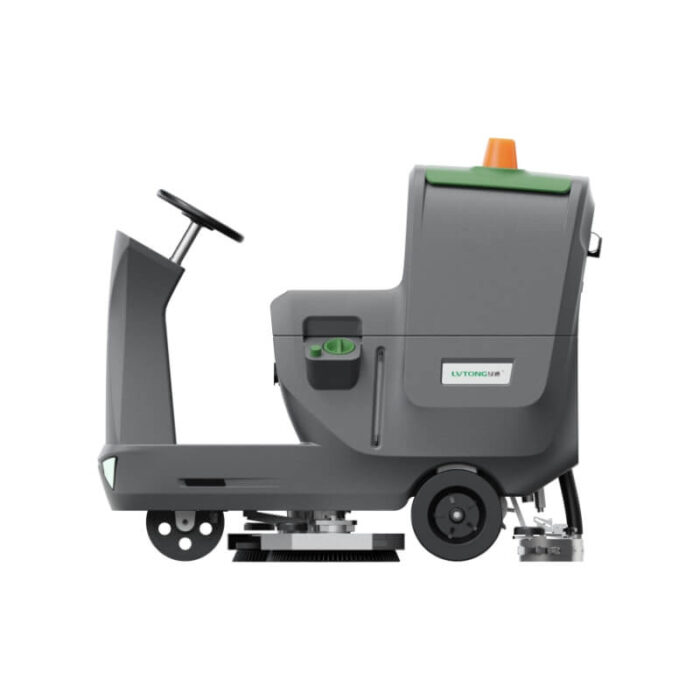
 From the perspective of total cost of ownership (TCO) analysis, its reliability is directly translated into financial advantages. Although the initial purchase price of the s6 industrial driving floor scrubber is approximately $35,000, its high-strength components keep the annual maintenance cost within 5% of the purchase cost, which is far lower than the industry average of 15%. Within a five-year cycle, one piece of equipment can replace at least eight full-time workers, reducing labor costs by 60%, and the return on investment (ROI) typically reaches 180% within 18 months. This is similar to the business model of Amazon's warehouse centers that use automated logistics robots to reduce sorting costs. s6 has created similar economies of scale through automated cleaning.
Its integrated intelligent diagnosis and predictive maintenance system is the "digital guardian" of reliability. The system monitors parameters such as brush pressure, battery voltage and water flow rate in real time through over 50 sensors, and can warn of potential faults 200 hours in advance, reducing the frequency of unplanned maintenance by 70%. The data analysis platform can generate clean path, energy consumption and efficiency reports, helping managers optimize resource utilization by 25%. Just as aircraft engine manufacturers use real-time data streams to prevent in-flight parking, the intelligent network of the s6 ensures the continuity and safety of cleaning operations.
Facing the harshest working conditions, such as port warehouses or chemical areas, the corrosion-resistant design and protection level up to IP65 of the S6 industrial ride on floor scrubber enable it to operate stably in environments with 95% humidity and high dust density. Its brush plate can provide a downward pressure of up to 100 bar, which is sufficient to remove industrial stains that have accumulated for many years. According to the assessment report of a certain international port group in 2023, after the introduction of this series of equipment, the cleanliness compliance score of its container yard area jumped from 75 points to 95 points, and the rate of safety accidents decreased by 40% compared with the previous period. Choosing the s6 industrial driving floor scrubber is not merely about selecting a device, but also about choosing a heavy-duty cleaning solution that has been rigibly verified by data. It transforms unpredictable operational risks into stable and calculable production capacity output.
From the perspective of total cost of ownership (TCO) analysis, its reliability is directly translated into financial advantages. Although the initial purchase price of the s6 industrial driving floor scrubber is approximately $35,000, its high-strength components keep the annual maintenance cost within 5% of the purchase cost, which is far lower than the industry average of 15%. Within a five-year cycle, one piece of equipment can replace at least eight full-time workers, reducing labor costs by 60%, and the return on investment (ROI) typically reaches 180% within 18 months. This is similar to the business model of Amazon's warehouse centers that use automated logistics robots to reduce sorting costs. s6 has created similar economies of scale through automated cleaning.
Its integrated intelligent diagnosis and predictive maintenance system is the "digital guardian" of reliability. The system monitors parameters such as brush pressure, battery voltage and water flow rate in real time through over 50 sensors, and can warn of potential faults 200 hours in advance, reducing the frequency of unplanned maintenance by 70%. The data analysis platform can generate clean path, energy consumption and efficiency reports, helping managers optimize resource utilization by 25%. Just as aircraft engine manufacturers use real-time data streams to prevent in-flight parking, the intelligent network of the s6 ensures the continuity and safety of cleaning operations.
Facing the harshest working conditions, such as port warehouses or chemical areas, the corrosion-resistant design and protection level up to IP65 of the S6 industrial ride on floor scrubber enable it to operate stably in environments with 95% humidity and high dust density. Its brush plate can provide a downward pressure of up to 100 bar, which is sufficient to remove industrial stains that have accumulated for many years. According to the assessment report of a certain international port group in 2023, after the introduction of this series of equipment, the cleanliness compliance score of its container yard area jumped from 75 points to 95 points, and the rate of safety accidents decreased by 40% compared with the previous period. Choosing the s6 industrial driving floor scrubber is not merely about selecting a device, but also about choosing a heavy-duty cleaning solution that has been rigibly verified by data. It transforms unpredictable operational risks into stable and calculable production capacity output.What makes the s6 industrial ride on floor scrubber a reliable heavy-duty choice?
In harsh industrial environments, the structural strength of equipment determines its life cycle. The frame of the S6 industrial ride on floor scrubber is made of high-tensile steel, and the sheet thickness of the key parts is up to 3 millimeters, which can withstand a continuous load of more than 2,000 kilograms. Its drive motor has a power of up to 5.5 kilowatts, providing a cleaning speed of up to 10 kilometers per hour, yet ensuring that the performance deviation does not exceed 5% within the ambient temperature range of -10°C to 50°C. According to statistics from the world's top 500 manufacturing plants, the average time between failures (MTBF) of such heavy equipment exceeds 3,000 hours, reducing the probability of unexpected downtime by more than 80%. Its design philosophy is in line with the durability standards of heavy-duty trucks.
In terms of cleaning efficiency and coverage, the s6 industrial driving floor scrubber has demonstrated overwhelming data. Its dual-brush system is 85 centimeters wide and, in combination with a high-flow water tank capable of handling 100 liters per minute, can achieve a single coverage of over 10,000 square meters of cleaning area. The cleaning efficiency is 500% of that of standard hand-pushed equipment. A case from an automotive manufacturing workshop shows that this equipment can complete the treatment of 50,000 square meters of epoxy resin floor within 2 hours, which would take 8 hours with traditional methods. It can remove oil stains as high as 90 grams per square meter and increase the water recovery rate to 98%. This directly echoes the wave of Industry 4.0's pursuit of ultimate production efficiency.
From the perspective of total cost of ownership (TCO) analysis, its reliability is directly translated into financial advantages. Although the initial purchase price of the s6 industrial driving floor scrubber is approximately $35,000, its high-strength components keep the annual maintenance cost within 5% of the purchase cost, which is far lower than the industry average of 15%. Within a five-year cycle, one piece of equipment can replace at least eight full-time workers, reducing labor costs by 60%, and the return on investment (ROI) typically reaches 180% within 18 months. This is similar to the business model of Amazon's warehouse centers that use automated logistics robots to reduce sorting costs. s6 has created similar economies of scale through automated cleaning.
Its integrated intelligent diagnosis and predictive maintenance system is the "digital guardian" of reliability. The system monitors parameters such as brush pressure, battery voltage and water flow rate in real time through over 50 sensors, and can warn of potential faults 200 hours in advance, reducing the frequency of unplanned maintenance by 70%. The data analysis platform can generate clean path, energy consumption and efficiency reports, helping managers optimize resource utilization by 25%. Just as aircraft engine manufacturers use real-time data streams to prevent in-flight parking, the intelligent network of the s6 ensures the continuity and safety of cleaning operations.
Facing the harshest working conditions, such as port warehouses or chemical areas, the corrosion-resistant design and protection level up to IP65 of the S6 industrial ride on floor scrubber enable it to operate stably in environments with 95% humidity and high dust density. Its brush plate can provide a downward pressure of up to 100 bar, which is sufficient to remove industrial stains that have accumulated for many years. According to the assessment report of a certain international port group in 2023, after the introduction of this series of equipment, the cleanliness compliance score of its container yard area jumped from 75 points to 95 points, and the rate of safety accidents decreased by 40% compared with the previous period. Choosing the s6 industrial driving floor scrubber is not merely about selecting a device, but also about choosing a heavy-duty cleaning solution that has been rigibly verified by data. It transforms unpredictable operational risks into stable and calculable production capacity output.
From the perspective of total cost of ownership (TCO) analysis, its reliability is directly translated into financial advantages. Although the initial purchase price of the s6 industrial driving floor scrubber is approximately $35,000, its high-strength components keep the annual maintenance cost within 5% of the purchase cost, which is far lower than the industry average of 15%. Within a five-year cycle, one piece of equipment can replace at least eight full-time workers, reducing labor costs by 60%, and the return on investment (ROI) typically reaches 180% within 18 months. This is similar to the business model of Amazon's warehouse centers that use automated logistics robots to reduce sorting costs. s6 has created similar economies of scale through automated cleaning.
Its integrated intelligent diagnosis and predictive maintenance system is the "digital guardian" of reliability. The system monitors parameters such as brush pressure, battery voltage and water flow rate in real time through over 50 sensors, and can warn of potential faults 200 hours in advance, reducing the frequency of unplanned maintenance by 70%. The data analysis platform can generate clean path, energy consumption and efficiency reports, helping managers optimize resource utilization by 25%. Just as aircraft engine manufacturers use real-time data streams to prevent in-flight parking, the intelligent network of the s6 ensures the continuity and safety of cleaning operations.
Facing the harshest working conditions, such as port warehouses or chemical areas, the corrosion-resistant design and protection level up to IP65 of the S6 industrial ride on floor scrubber enable it to operate stably in environments with 95% humidity and high dust density. Its brush plate can provide a downward pressure of up to 100 bar, which is sufficient to remove industrial stains that have accumulated for many years. According to the assessment report of a certain international port group in 2023, after the introduction of this series of equipment, the cleanliness compliance score of its container yard area jumped from 75 points to 95 points, and the rate of safety accidents decreased by 40% compared with the previous period. Choosing the s6 industrial driving floor scrubber is not merely about selecting a device, but also about choosing a heavy-duty cleaning solution that has been rigibly verified by data. It transforms unpredictable operational risks into stable and calculable production capacity output.Specs that actually fit your face — and your story.
Hand-picked frames from 38 ateliers, lenses cut in 48 hours, and a 30-day "Love Them or Lose Them" return window.